Chippewa County Dog Registration Information
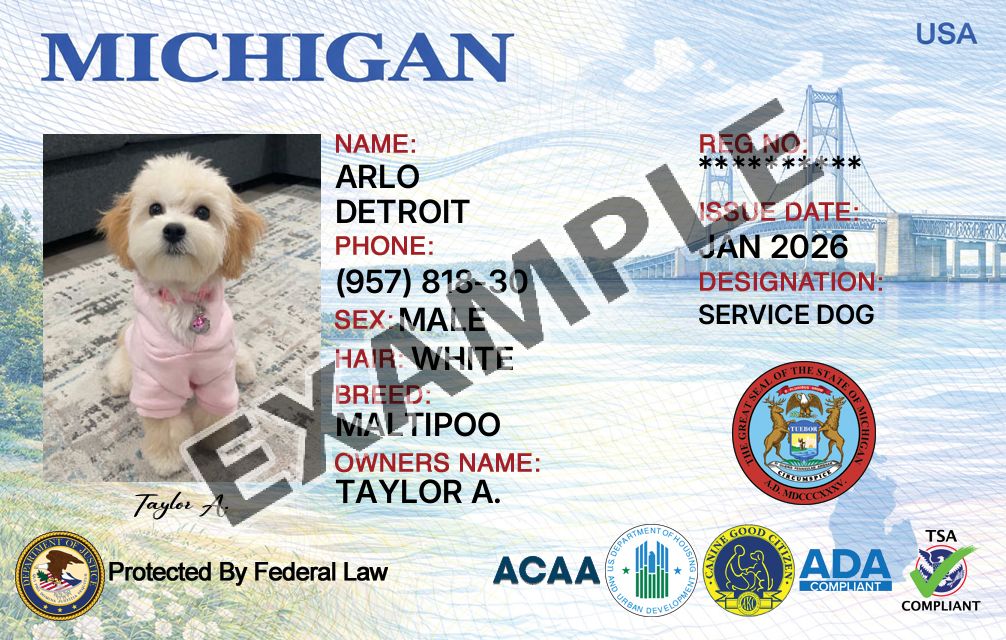
Service Dogs and Emotional Support Animals in Chippewa, Michigan
If you’re searching for where do I register my dog in Chippewa County, Michigan for my service dog or emotional support dog, the key point is this: there isn’t a separate “service dog registration” or “ESA registration” required by Chippewa County. What most residents actually need is a dog license in Chippewa County, Michigan—which is tied to rabies vaccination and is typically handled through local or county government offices.
This page explains where to register a dog in Chippewa County, Michigan, which official offices commonly handle licensing, what paperwork you may need, and how dog licensing differs from service dog legal status and emotional support animal rules.
Where to Register or License Your Dog in Chippewa County, Michigan
Because licensing is often handled at the county or city level, below are several example official offices within Chippewa County, Michigan. If you are unsure which office applies to your address, start with the county animal shelter/animal control or the county finance mailing option.
Official offices commonly involved in dog licensing and enforcement
| Office | Address | Phone | Office Hours | |
|---|---|---|---|---|
|
Chippewa County Animal Shelter
County animal shelter / animal control contact
|
3660 South Mackinac Trail
Sault Ste. Marie, MI 49783
|
906-632-2519 | Not listed |
Mon: 12:00pm–5:00pm
Tue–Fri: 11:00am–5:00pm
Sat: 12:00pm–4:00pm
Closed on county holidays
|
|
Chippewa County Finance (Dog License by Mail)
Mail-in licensing payments/forms
|
319 Court Street
Sault Ste. Marie, MI 49783
|
Not listed | Not listed | Not listed |
|
Chippewa County Treasurer
County finance office (general county funds/receipting)
|
319 Court Street
Sault Ste. Marie, MI 49783
|
906-635-6308 | Not listed | Mon–Fri: 8:00am–5:00pm (except holidays) |
|
City of Sault Ste. Marie — City Clerk (City Hall)
City office that handles various permits and licenses
|
225 E. Portage Ave
Sault Ste. Marie, MI 49783
|
906-632-5715 | Not listed | Not listed on the clerk page |
|
Chippewa County Clerk
County office (records, elections, licensing categories)
|
319 Court Street
Sault Ste. Marie, MI 49783
|
906-635-6300 | Not listed | Mon–Fri: 8:00am–5:00pm |
Quick start: the two most common places to license
- In person: Chippewa County Animal Shelter (often the most direct option for dog license questions, tags, and guidance).
- By mail: Chippewa County Finance at 319 Court Street, Sault Ste. Marie, MI 49783 (send form + required proofs + payment).
Overview of Dog Licensing in Chippewa County, Michigan
What “registering your dog” usually means
When people ask where to register a dog in Chippewa County, Michigan, they’re usually referring to obtaining (or renewing) a county dog license tag. In Chippewa County, licensing is tied to rabies vaccination and helps local agencies identify dogs, enforce public health rules, and reunite lost pets with their owners.
Age requirement and rabies link
Chippewa County’s licensing materials reference Michigan law requiring that dogs four (4) months or older must be vaccinated against rabies and have a current dog license. In practical terms, if you show up without proof of a current rabies vaccination (including the expiration date), you should expect the office to refuse to issue a license.
Fees and timing (why dates matter)
License fees can vary depending on whether the dog is spayed/neutered and whether you’re purchasing before or after the county’s annual deadline. Chippewa County’s 2026 licensing notice indicates that fees paid on or after March 1, 2026 are doubled. If you’re renewing, paying early can help you avoid the higher amount and reduce last-minute stress.
How Dog Licensing Works Locally in Chippewa County, Michigan
Most licensing is handled locally (county and sometimes city level)
In Michigan, dog licensing is often administered locally. In Chippewa County, the county animal shelter/animal control function and county finance offices are key touchpoints for licensing, and municipalities like the City of Sault Ste. Marie may also help direct residents to the correct licensing path depending on where they live.
Common ways to get a dog license in Chippewa County, Michigan
Option 1: By mail (Chippewa County Finance)
- Complete the county dog license application form.
- Include proof of current rabies vaccination (with expiration) and any spay/neuter proof for reduced fees.
- Include payment by check payable to Chippewa County.
- Mail to: Chippewa County Finance, 319 Court Street, Sault Ste. Marie, MI 49783.
Option 2: In person (Chippewa County Animal Shelter)
Bring proof of rabies vaccination (and spay/neuter proof if applicable) plus payment. If you have questions about enforcement, tag replacement, or what counts as acceptable documentation, the shelter is often the most practical place to start.
Option 3: In person (Chippewa County Courthouse / Finance Office)
The county dog license notice also indicates an in-person option at the courthouse finance office. If you choose this route, confirm accepted payment types and the correct counter before you arrive.
Rabies vaccination requirements (what enforcement is really about)
A dog license is closely connected to rabies compliance. Chippewa County’s animal shelter information emphasizes that a dog must have a current rabies vaccination to purchase a license, and it describes quarantine requirements and boarding costs that may apply when an animal bites and lacks current rabies vaccination status. This is why local agencies treat rabies paperwork as non-negotiable.
What the license tag does (and does not) do
- Does: show your dog is licensed for the current period, helps identify ownership, supports shelter operations, and supports enforcement.
- Does not: create service dog rights, prove disability status, or transform a pet into an emotional support animal.
Service Dog Laws in Chippewa County, Michigan
Service dog legal status is not a county “registration”
If you’re licensing a dog that is (or will be) a service animal, you still typically need the same local licensing steps as any other dog: get the rabies vaccine and obtain a current local license tag. The service dog concept, however, is about disability access rights and task-trained assistance—not about paying a license fee or obtaining a county tag.
Dog license vs. service dog: the practical difference
| Item | What it is | Who handles it | What it proves |
|---|---|---|---|
| Dog license in Chippewa County, Michigan | A local license tag tied to rabies compliance and identification | County/local offices (animal shelter/finance) | That the dog is licensed and meets licensing prerequisites |
| Service dog | A dog trained to do work or perform tasks for a person with a disability | Not “issued” by the county; status comes from disability law and the dog’s training | Access rights in many public settings (subject to lawful limits) |
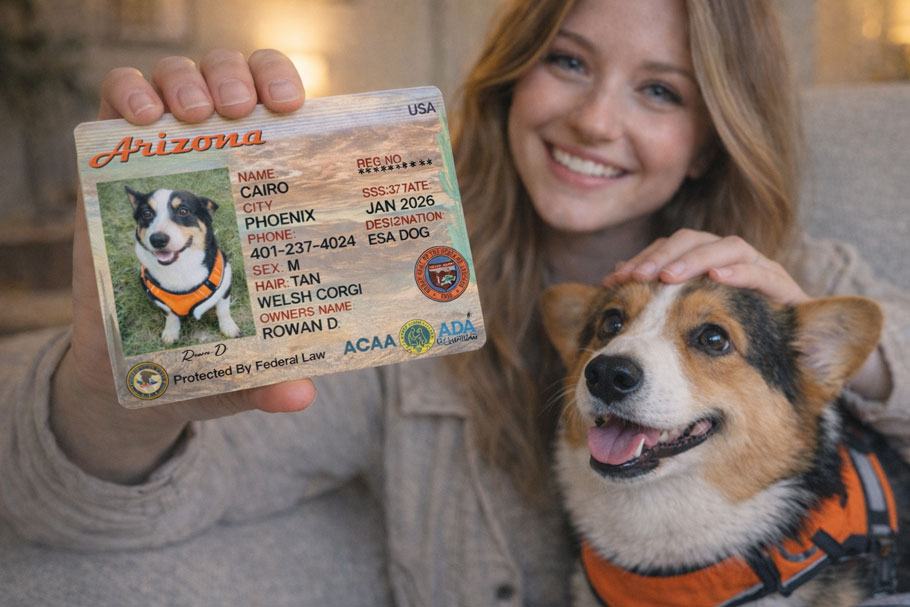
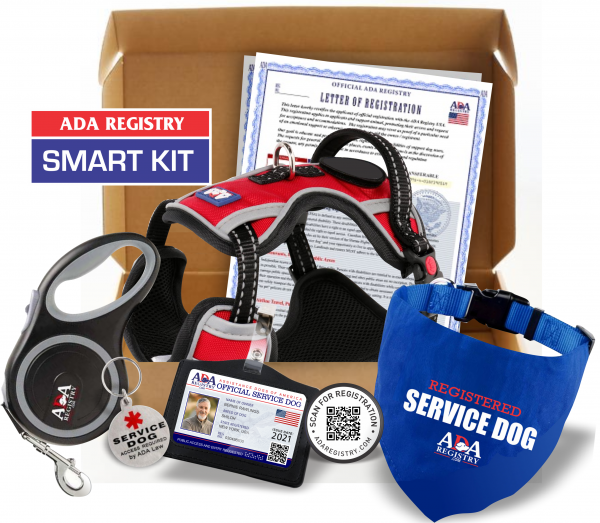
Avoid “service dog registration” scams
Many websites market “official service dog registration” or “certification.” Those vendor programs are not the same as a local dog license, and they generally are not required by county government. If your goal is to be compliant in Chippewa County, focus on your animal control dog license Chippewa County, Michigan steps (rabies + local license) and on understanding legitimate service dog rules.
Emotional Support Animal Rules in Chippewa County, Michigan
An ESA is not a “license category” at the county counter
An emotional support animal (ESA) generally refers to an animal that provides comfort related to a person’s disability. In everyday county licensing, ESAs are typically treated like any other dog for licensing purposes: the dog still needs rabies vaccination proof and a current license tag if required by local rules.
Where ESAs matter most: housing requests
ESAs most commonly come up in housing contexts (for example, requesting a reasonable accommodation to keep an animal in housing that otherwise restricts pets). That process is usually handled between the resident and the housing provider—not through a county dog licensing office. Even when a landlord allows an ESA as an accommodation, the dog may still need a current local license and rabies vaccination.
Dog license vs. emotional support animal: the practical difference
- Dog license: local compliance step (rabies + local licensing). It applies broadly to dogs in the county.
- ESA: a disability-related accommodation concept that most often affects housing rules; it is not the same as a county-issued registration.
Frequently Asked Questions
For most residents, there is no special county “service dog registration” separate from regular licensing. If your dog is required to be licensed, you typically follow the same licensing steps (rabies proof + license tag). Service dog rights are based on disability laws and task training, not a county-issued service-dog certificate.
Start with the Chippewa County Animal Shelter or the county “Dog License by Mail” option through Chippewa County Finance. If you need help figuring out which office applies to your exact address, the City Clerk at Sault Ste. Marie City Hall can also help route you to the right place.
This is why many people searching where to register a dog in Chippewa County, Michigan are told to check locally—because administration is often handled at the county/city level.
At minimum, expect to provide proof of a current rabies vaccination (showing the expiration date). If you want a reduced rate, bring proof your dog is spayed/neutered. You’ll also need payment (and for mail-in applications, a check payable to Chippewa County).
No. A local dog license is a standard licensing requirement tied to rabies and identification. “Service dog license” is a phrase people use informally, but service dog status is about training and disability access laws, not about a special license tag category.
Yes. Chippewa County provides a mail-in option through Chippewa County Finance. Mail the application, proof of rabies (and spay/neuter proof if needed), plus a check payable to Chippewa County, to 319 Court Street, Sault Ste. Marie, MI 49783.
Register A Dog In Other Michigan Counties
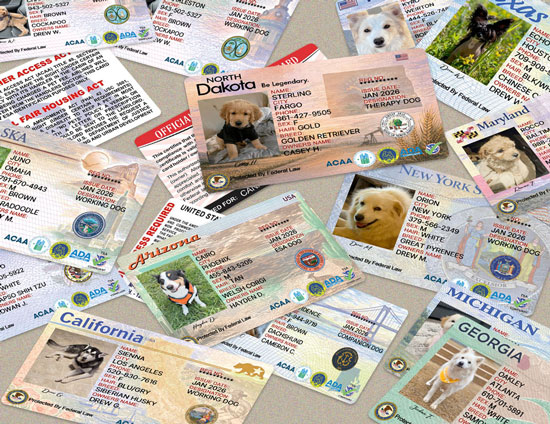
Select your county below to get started with your dog’s ID card. Requirements and license designs may vary by county, so choose your location to see the correct options and complete your pup’s registration.
- Alcona County Dog Registration
- Alger County Dog Registration
- Allegan County Dog Registration
- Alpena County Dog Registration
- Antrim County Dog Registration
- Arenac County Dog Registration
- Baraga County Dog Registration
- Barry County Dog Registration
- Bay County Dog Registration
- Benzie County Dog Registration
- Berrien County Dog Registration
- Branch County Dog Registration
- Calhoun County Dog Registration
- Cass County Dog Registration
- Charlevoix County Dog Registration
- Cheboygan County Dog Registration
- Clare County Dog Registration
- Crawford County Dog Registration
- Delta County Dog Registration
- Dickinson County Dog Registration
- Eaton County Dog Registration
- Emmet County Dog Registration
- Genesee County Dog Registration
- Gladwin County Dog Registration
- Gogebic County Dog Registration
- Grand Traverse County Dog Registration
- Gratiot County Dog Registration
- Hillsdale County Dog Registration
- Houghton County Dog Registration
- Huron County Dog Registration
- Ingham County Dog Registration
- Ionia County Dog Registration
- Iosco County Dog Registration
- Irom County Dog Registration
- Isabella County Dog Registration
- Jackson County Dog Registration
- Kalamazoo County Dog Registration
- Kalkaska County Dog Registration
- Kent County Dog Registration
- Keweenaw County Dog Registration
- Lake County Dog Registration
- Lapeer County Dog Registration
- Leelanau County Dog Registration
- Lenawee County Dog Registration
- Livingston County Dog Registration
- Luce County Dog Registration
- Mackinac County Dog Registration
- Macomb County Dog Registration
- Manistee County Dog Registration
- Marquette County Dog Registration
- Mason County Dog Registration
- Mecosta County Dog Registration
- Menominee County Dog Registration
- Midland County Dog Registration
- Missaukee County Dog Registration
- Monroe County Dog Registration
- Montcalm County Dog Registration
- Montmorency County Dog Registration
- Muskegon County Dog Registration
- Newaygo County Dog Registration
- Oakland County Dog Registration
- Oceana County Dog Registration
- Ogemaw County Dog Registration
- Ontonagon County Dog Registration
- Osceola County Dog Registration
- Oscoda County Dog Registration
- Otsego County Dog Registration
- Ottawa County Dog Registration
- Presque Isle County Dog Registration
- Roscommon County Dog Registration
- Saginaw County Dog Registration
- Sanilac County Dog Registration
- Schoolcraft County Dog Registration
- Shiawassee County Dog Registration
- St. Clair County Dog Registration
- St. Joseph County Dog Registration
- Tuscola County Dog Registration
- Van Buren County Dog Registration
- Washtenaw County Dog Registration
- Wayne County Dog Registration
- Wexford County Dog Registration